Sweet Corn and Olive Oil Ice Cream

Featuring the sweetness of locally grown corn with a medium Picual olive oil, this ice cream is a unique combination that will stand on its own for dessert. Australian Picual has a natural creaminess with a slight bitterness, making it an ideal addition to rich coconut milk and fresh corn.

olive oil corn ice cream 1

Sweet Corn and Olive Oil Ice Cream

  • Servings: 1 1/2 quarts
  • Print

4 large or 6 small ears fresh corn, shucked
1 can full-fat coconut milk (I’m a fan of Thai Kitchen)
1 1/4 cup unsweetened nondairy milk (I always use So Delicious Unsweetened Coconut Beverage for ice cream)
1/2 cup agave nectar
1/4 teaspoon fine sea salt
1/2 cup medium Picual olive oil, plus more for serving

Use a sharp knife to slice the kernels off the corn cobs. Put the kernels in a large saucepan. Put the cobs in the saucepan, as well, breaking them in half if necessary. Add the coconut milk, nondairy milk, agave nectar, and salt. Bring the mixture to a boil, then remove from heat. Cover, and let stand for 1 hour. Remove the cobs.

Using an immersion blender, purée the mixture until smooth (if you don’t have one, transfer the mixture to a blender or food processor and blend until smooth). Pass the mixture through a fine sieve, pressing down on the solids to get all the flavor. Discard the solids. Add the olive oil in a steady stream, whisking constantly, until smooth. Refrigerate the mixture until cold, at least 8 hours or overnight.

After the mixture has chilled, transfer the mixture to your ice cream maker and freeze according to manufacturer’s instructions. Enjoy right away for soft serve ice cream, or put it in a container and transfer it to the freezer for 4 hours, for a perfect consistency. Drizzle with olive oil, if desired, before serving.

If you don’t have an ice cream maker, check out the instructions here.

olive oil corn ice cream 2

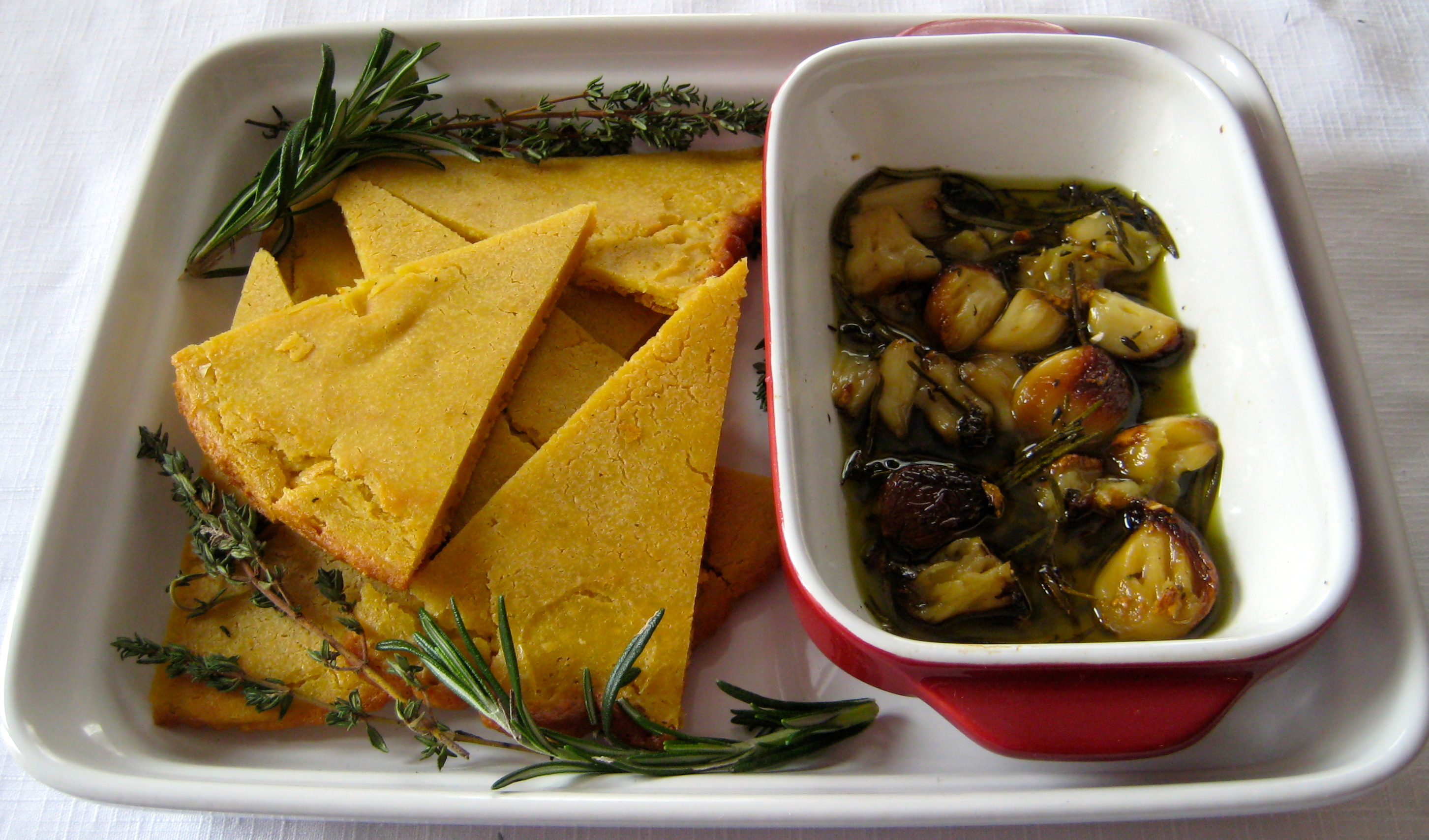
Socca with Roasted Garlic Dipping Oil

Getting down this basic socca recipe in your arsenal opens up a word of new flavors and options for dinnertime. For a bit of Mediterranean flair, add oregano, black olives, and sundried tomatoes before pouring the batter in the pan. You can also use the socca as a base for pizza toppings, or double the recipe and add veggies, for a spin on frittata. Use good quality olive oil for this one to get the best flavor.

socca with roasted garlic and herbs

Socca with Roasted Garlic Dipping Oil

For the socca:
1 cup chickpea flour
1 cup water
1 teaspoon fine sea or Himalayan salt
5 tablespoons good extra-virgin olive oil, divided (I like this one)

For the dipping oil:
1 bulb garlic
6 sprigs fresh thyme
6 sprigs fresh rosemary
1/4 cup good extra-virgin olive oil
Sea or Himalayan salt
Freshly ground pepper

To start the socca, put the chickpea flour, water, salt, and 2 tablespoons of the oil in a bowl. Whisk well to combine. Cover and let sit at room temperature for 2 hours.

After about an hour, preheat the oven to 425 degrees F. Cut about 1/8-inch off the top of the garlic bulb, just enough to expose the cloves. Put it in a small baking dish. Put the thyme and rosemary around it, and pour the olive oil on top. Sprinkle with salt and pepper. Cover tightly with foil and bake on the middle rack for 50 to 60 minutes, until the cloves are very soft and browned. Cool while finishing the socca.

Put a 12-inch cast iron pan in the oven and increase the temperature to 450 degrees F. Once the pan is hot and the oven is preheated, remove the pan from the oven and add 2 tablespoons of the oil. Return it to the oven for about 1 minute to heat the oil. Remove the pan from the oven and pour in the batter (it will sizzle) and spread it around the pan. Bake for 5 to 8 minutes, until the edges and bottom are golden brown, and the top is firm to the touch. Use a spatula to loosen the edges, and slide the socca onto a plate. Add the remaining olive oil to the pan and put it in the oven for 1 minute to heat it. Remove the pan from the oven and invert the socca back into the pan. Return it to the oven and bake for 3 to 5 minutes, until cooked through. Use a spatula to help slide the socca onto a cutting board. Cut into wedges.

Squeeze the garlic cloves into the oil, mashing if desired. Remove the sprigs, crumbling off some of the leaves into the oil. Serve warm with the socca wedges.

Pan-fried Polenta with Sundried Tomatoes

Pan-fried polenta is an ideal base for any main course dish. You can make the polenta ahead of time (I generally do it the day before), refrigerate it, then pan-fry it right before serving. When you’re not in the mood for pasta, rice, or some sort of ancient grain, this is a starchier side that can go with pretty much anything.

polenta

Pan-Fried Polenta with Sundried Tomatoes

Extra-virgin olive oil, for the pan and for frying
3 cups water
3 sundried tomatoes (not in oil), finely chopped
1/2 teaspoon fine sea or Himalayan salt
3/4 cup stone-ground cornmeal
1 tablespoon nondairy buttery spread (optional, but recommended)

Line an 8-inch square pan with parchment paper. Brush with olive oil.

Put the water, sundried tomatoes, and salt in a large saucepan. Bring to a boil on medium-high heat. Add the cornmeal in a steady stream, whisking constantly to avoid clumping. Reduce the heat to low. Cook for 15 minutes, continually stirring the cornmeal mixture with a wooden spoon, very thick and the cornmeal is tender, not raw. Use a spatula to scrape the mixture into the prepared pan. Smooth evenly. Refrigerate until firm, about 2 hours, or until you are ready to serve.

Use the parchment paper to lift the solid polenta out of the pan. Cut into 9 squares, then each square into 2 triangles. Heat about 1/2 tablespoon of the olive oil in a nonstick skillet on medium-high heat. Fry the polenta until brown, about 3 to 5 minutes per side–I also fry the edges, not just the faces. Repeat with the remaining polenta triangles, transferring each to a plate and covering with foil to keep warm. Serve warm.